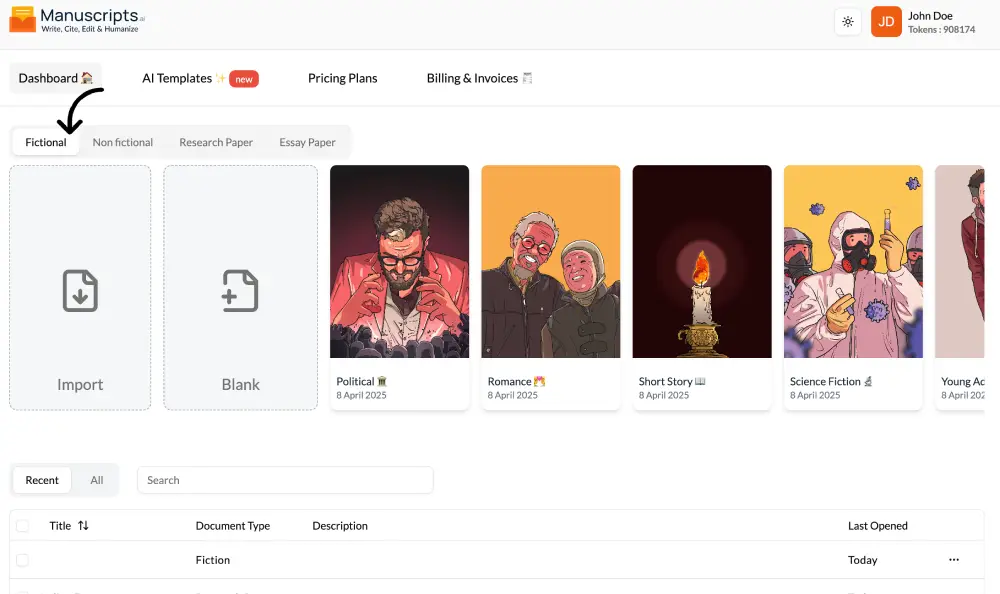
At the very core of every significant writing project lies a world of information. For a novelist, it’s a universe of characters, settings, and intricate plot points. For a researcher, it’s a web of sources, arguments, data, and citations. Managing this foundational knowledge is one of the most critical and challenging aspects of the writing process. This is the precise challenge the Lore Book in Manuscripts.ai is engineered to solve.
The Lore Book is not merely a folder for your notes or a simple database. It is the central, intelligent brain of your project. It’s a dynamic, interconnected repository that serves as the single source of truth for your work. More importantly, it is a living document that our AI Assistant actively reads, understands, and utilizes to provide context-aware suggestions, generate consistent content, and help you maintain perfect coherence from the first page to the last.
Whether you are building a fictional empire from scratch or constructing a rigorous academic argument, the Lore Book adapts to your needs, providing a tailored structure to organize your thoughts and materials. This guide will explore the two primary facets of this powerful tool: its application for fiction and creative non-fiction, and its indispensable role in research and essay writing.
Lore Book for Fiction: Your World-Building Bible
For authors of fiction, the Lore Book is the ultimate tool for world-building and narrative management. It addresses the timeless challenge of consistency, ensuring that the rules of your world, the histories of your characters, and the threads of your plot remain untangled and coherent throughout a sprawling manuscript. By investing time in your Lore Book, you are essentially teaching the AI the encyclopedia of your story.
Key Components for Fiction Writers:
- Braindump: This is the genesis of your world, a completely unstructured space for your rawest ideas. It’s a digital canvas for stream-of-consciousness thoughts, snippets of dialogue, “what if” scenarios, character name ideas, or links to inspirational images. Before structure comes the spark, and the Braindump is where you capture it. Every great story begins as a collection of fragments, and this section allows you to gather them without judgment or the pressure of organization.
- Genre & Writing Style: This section functions as the master directive for the AI, defining the very DNA of your narrative. Here, you instruct the AI on the precise tone, voice, and style of your project. Instead of a generic “Fantasy,” you might specify “Grimdark Epic Fantasy with political intrigue, inspired by the prose of George R.R. Martin.” This detailed instruction ensures that when you ask the AI to describe a castle, it generates a description of a cold, imposing fortress rather than a fairytale palace. It’s the difference between a generic assistant and one that speaks your unique authorial language.
- Synopsis: Here, you craft and refine your story’s blueprint. You can begin with a single-sentence logline and use the AI to iteratively expand it into a full, multi-page treatment. This section serves as a high-level guide for the narrative. The AI will reference the synopsis to understand the main plot points, the inciting incident, the climax, and the resolution, ensuring its suggestions for plot developments or character motivations align with your overall story structure.
- Characters & Things: This is the heart of your fictional world—a detailed, interconnected database of every important person, place, object, and concept.
- Characters: Each character entry is a comprehensive profile containing their backstory, physical appearance, personality traits, motivations, fears, and speaking style. You can link characters to one another to define relationships (e.g., mentor, rival, family). When you ask the AI to write dialogue for a character, it will draw from this profile to ensure their voice is authentic and consistent.
- Things: This catch-all category is for everything else that makes your world unique. Create entries for the capital city of “Veridia,” the magical sword “Glimmerfang,” the powerful “Mages’ Guild,” or the complex rules of your “Aether-based magic system.” The more detail you provide, the more deeply the AI understands your world.
- Outline & Scene Beats: This is where you architect the narrative flow. The Outline section is for your high-level, chapter-by-chapter plan. The Scene Beats section allows for more granular planning, breaking down each chapter into a sequence of key moments or actions. This meticulous planning helps you perfect your story’s pacing and ensures that every scene serves a purpose, driving the plot forward or revealing character. The AI can assist here by brainstorming potential obstacles, suggesting scene transitions, or ensuring each beat logically follows the last.
Lore Book for Research & Essay Papers: Your Academic Command Center
For students, academics, and non-fiction writers, the Lore Book transforms into a powerful research and knowledge management tool. It tackles the primary challenges of scholarly work: organizing vast amounts of information, constructing a logical and evidence-based argument, and ensuring meticulous attribution of sources. It is the structured environment where raw research is synthesized into a coherent, persuasive final paper.
Key Components for Researchers:
- Research Work: This is your dynamic, intelligent annotated bibliography and the foundation of your entire project. For each source (article, book, website), you create an entry containing:
- Full Citation Information: Capture the bibliographic details to streamline your referencing process later.
- AI-Powered Summaries: Paste in an abstract or an entire article and use the AI to generate a concise summary of its core argument, methodology, and findings.
- Personal Annotation: Add your own notes, critiques, and analysis. How does this source support or challenge your thesis? How does it connect to other research?
- Key Quotes: Extract the exact phrasing you might want to use in your paper.
- Tags: Most importantly, tag each entry with keywords (economic_impact, solar_power, policy_analysis). This allows you to instantly filter and retrieve all your notes on a specific sub-topic while you are writing.
- Topic & Writing Style: This section sets your academic mission.
- Thesis Statement / Research Question: This is a dedicated space to draft, refine, and finalize the single most important sentence of your paper. Use the AI as a sparring partner to make your thesis more arguable, specific, and concise.
- Writing Style & Format: Define the rigid conventions of your assignment. Specify the required citation style (e.g., APA 7, MLA 9, Chicago), the required tone (e.g., formal, objective), and any other formatting rules. The AI will strictly adhere to these guidelines for all generated text and citations.
- Outline / Argument Structure: Before writing, you must build a logical framework. This dynamic outliner is designed for just that. You can create the major sections of your paper (Introduction, Literature Review, Analysis, etc.) and then build out each section with topic sentences for every paragraph. Crucially, you can link each point in your outline directly to the supporting evidence in your “Research Work” database. This creates an unbreakable chain of logic from your claims to the evidence that backs them up.
By meticulously building your Lore Book, you are creating a bespoke, intelligent context for your project. You are transforming the AI from a general-purpose tool into a specialized assistant that is a true expert on your world and your research. This deep integration is what makes the Lore Book the most powerful feature in Manuscripts.ai for tackling ambitious writing projects.