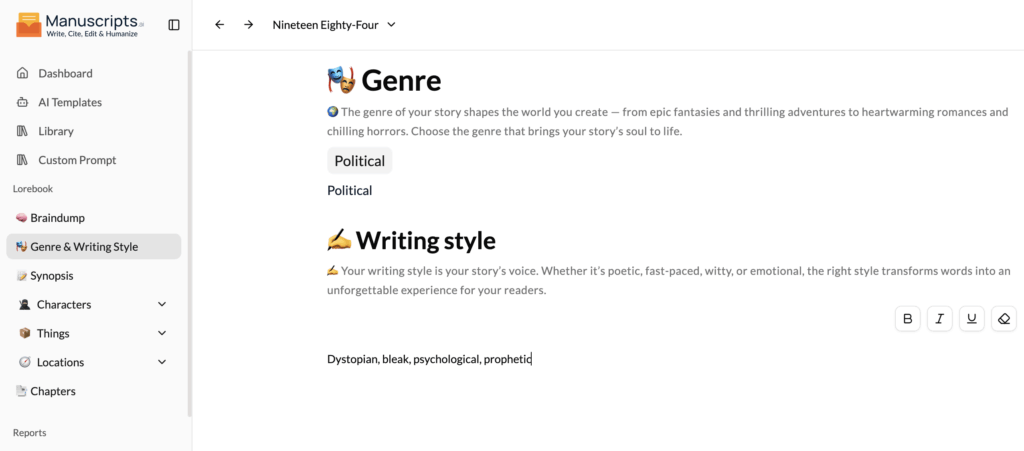
If the Lore Book is the brain of your project, the Genre & Writing Style section is its very soul. This is arguably the most impactful section you will configure, as it provides the AI with its core creative instructions. It’s the filter through which every AI suggestion, generation, and edit is passed.
Getting this section right is the difference between having a generic, all-purpose AI and a bespoke, specialized co-writer that deeply understands your artistic vision and speaks in your unique authorial voice. It dictates the tone, mood, pacing, vocabulary, and literary conventions that the AI will use, ensuring that its contributions feel like a natural extension of your own writing.
The Power of Specificity
The AI’s ability to assist you is directly proportional to the quality of the instructions you give it. Vague inputs will yield vague results. This section demands specificity.
Poor Example:
- Genre: Fantasy
- Writing Style: Third-person
With this input, asking the AI to “describe a forest” might result in a generic, fairytale-like description.
Excellent Example:
- Genre: Adult Grimdark Fantasy with elements of Lovecraftian horror. Focus on political intrigue and the psychological toll of dark magic.
- Writing Style: Close third-person limited perspective, tightly focused on the protagonist’s sensory details and internal paranoia. Prose should be stark and literary, with a preference for shorter, impactful sentences, similar to the style of Cormac McCarthy. Avoid modern colloquialisms.
With this input, the same request to “describe a forest” will produce a vastly different and more appropriate result: a description of a menacing, claustrophobic woods, filled with unsettling sounds and a palpable sense of dread, all filtered through the protagonist’s fearful psyche.
Key Components to Define
When filling out this section, consider the following elements:
Genre
Go beyond broad categories. Drill down into sub-genres and even mix them.
- Instead of Sci-Fi, try Hard Sci-Fi Military Space Opera with a focus on realistic physics and ship-to-ship combat.
- Instead of Romance, try Contemporary Enemies-to-Lovers Romance set in the competitive world of professional baking, with a light, humorous tone.
- Instead of Thriller, try Legal Thriller with an unreliable narrator and a complex, twisting plot, inspired by the works of John Grisham.
Writing Style & Prose
This is where you define your authorial fingerprint.
- Perspective/Point of View (POV): Be explicit. First-person past tense, Third-person omniscient, Epistolary (told through letters and documents).
- Tone & Mood: How do you want the reader to feel? Nostalgic and melancholic, Fast-paced and exhilarating, Satirical and witty, Bleak and oppressive.
- Prose Stylings: Describe the very texture of your sentences. Lyrical and flowing with complex sentences, Minimalist and direct, Dialogue-heavy, Rich in sensory detail.
- Authorial Influences: Citing other authors is a powerful shortcut. Mentioning in the style of Neil Gaiman or with the pacing of a Dan Brown novel gives the AI a rich dataset to draw from.
“Dos and Don’ts”: You can even provide specific rules. Do use metaphors related to nature. Don’t use adverbs unless absolutely necessary.