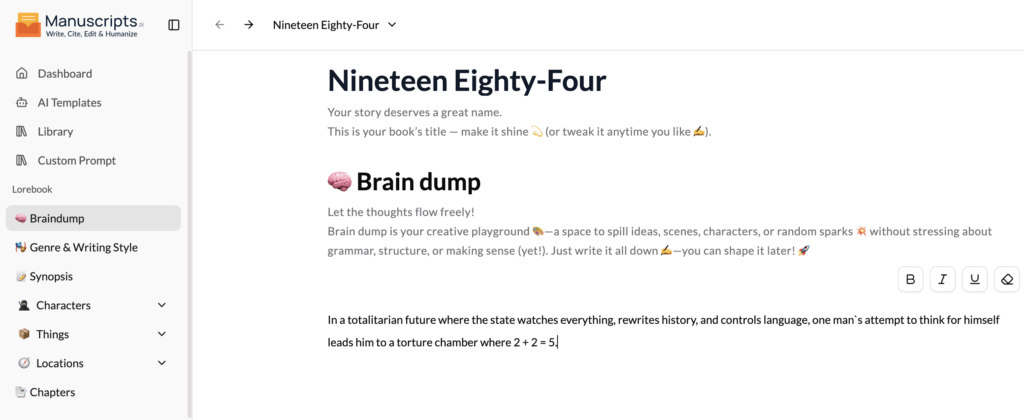
Every masterpiece begins not with a perfect sentence, but with a chaotic storm of inspiration. It’s a fleeting image, a snippet of overheard dialogue, a compelling “what if?” that sparks the imagination. The greatest challenge for any writer is capturing this raw, untamed energy before it vanishes. This is the precise purpose of the Braindump section in your Lore Book.
The Braindump is your private, unstructured, and judgment-free creative sandbox. It is the digital equivalent of a napkin sketch, a scattered collection of sticky notes, or a late-night voice memo. It is intentionally designed to be the antithesis of a structured outline, freeing you from the pressure of organization and allowing your ideas to flow in their most primal, unfiltered form.
The Philosophy: Embracing the Chaos
Creative thought is not linear. It’s a messy, associative, and often unpredictable process. The Braindump honors this reality. By providing a space with no rules, it encourages you to:
- Capture Everything: No idea is too small, too strange, or too underdeveloped. Whether it’s a single word, a character name, a vague feeling, or a grand vision for a final scene, the Braindump is its home.
- Lower the Stakes: The fear of the blank page often comes from the pressure to write something “good.” The Braindump has no such expectations. Its purpose is quantity over quality, exploration over execution.
- Discover Connections: As your Braindump grows, you’ll begin to see unexpected connections between disparate ideas. A character trait you jotted down last week might be the perfect fit for a plot point you thought of this morning. It becomes a rich repository of creative potential that you can mine throughout your writing process.
How to Use the Braindump Effectively
While there are no rules, here are some practical ways to leverage the Braindump to its fullest potential:
- Stream of Consciousness: Open the Braindump and just start typing. Write down whatever is on your mind related to your story. Don’t worry about grammar, spelling, or coherence. Follow your train of thought wherever it leads.
- Idea Fragments: Use it as a repository for disconnected snippets:
- Dialogue: “The only thing worse than a lie is a truth that no one believes.”
- Imagery: A city built on the back of a colossal, sleeping dragon.
- Character Moments: A scene where the stoic warrior is caught secretly tending to a wounded bird.
- Titles: List of potential book titles: The Last Ember, Cipher of Souls, The Onyx Rebellion.
- Mind Mapping: Use simple text indentation to create fluid, evolving mind maps.
Main Plot: Ancient Artifact Rediscovered
– Faction 1: The Royal Mages (Want to control it)
– Leader: Archmage Valerius (Ruthless, believes order is paramount)
– Faction 2: The Shadow Syndicate (Want to sell it)
– Protagonist: Caught in the middle
– Motivation: Needs the artifact to cure his sister’s illness
Inspiration Links: Paste URLs to images, articles, songs, or videos that evoke the tone and atmosphere of your story.
From Braindump to Structure
The Braindump is not a final destination; it is the starting point. It is the fertile ground from which the more structured elements of your Lore Book will grow. Your workflow might look like this:
- Populate: Spend your initial creative sessions filling the Braindump with ideas.
- Excavate: Periodically review your Braindump. Look for recurring themes and promising concepts.
- Migrate: As an idea solidifies, move it to the appropriate section of the Lore Book. That cool character name you wrote down? Create a full profile for them in Characters & Things. That compelling plot point? Add it to your Synopsis or Outline.
By starting with the Braindump, you ensure that the foundation of your story is built not on rigid formulas, but on a rich, organic collection of your most inspired thoughts.