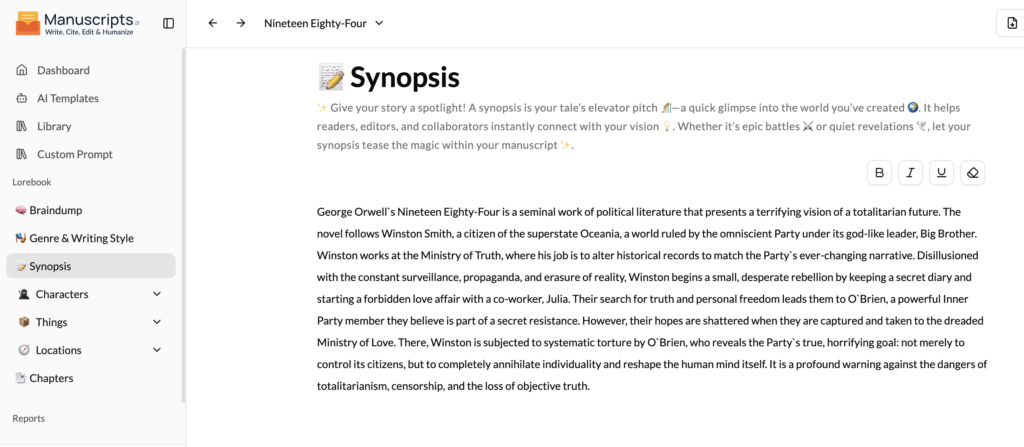
Before an architect lays the first brick, they draft a detailed blueprint. For a writer, the Synopsis serves this exact function. It is the high-level architectural plan for your entire narrative, a concise summary of your story from its inciting incident to its final resolution.
The Synopsis section of the Lore Book is your dedicated space for crafting, refining, and perfecting this crucial document. It’s a dynamic tool that allows you to see your entire plot at a glance, identify structural weaknesses, and ensure your story is built on a solid foundation before you invest hundreds of hours in drafting chapters. More importantly, the AI treats your synopsis as the “canon” of your plot, constantly referencing it to ensure that its suggestions for subplots, character actions, and scene developments align with your core narrative.
The Purpose of the Synopsis
A well-crafted synopsis is an invaluable tool for several reasons:
- Clarity of Vision: The act of condensing your entire story into a few pages forces you to make critical decisions about your plot, characters, and themes. It distills your story to its essential elements.
- Structural Analysis: It provides a bird’s-eye view of your narrative structure. You can easily assess your pacing, see if your midpoint twist is effective, and ensure your climax is a satisfying culmination of the preceding events.
- AI Guidance: For Manuscripts.ai, the synopsis is the primary plot guide. When you’re in Chapter 3 and ask the AI to suggest a complication, it will consult the synopsis to offer ideas that set up future events in Chapter 10, creating powerful foreshadowing and narrative cohesion.
- Professional Tool: Should you choose to seek publication, a synopsis is a standard requirement for pitching your manuscript to agents and editors.
An Iterative Workflow
The Synopsis section is designed for an iterative, top-down writing process. You don’t need a perfect, multi-page document from the start.
Step 1: The Logline Begin with a single, compelling sentence that encapsulates the core conflict of your story. This is your “elevator pitch.”
- Example: A reclusive librarian discovers a magical book that writes the future, and must go on the run when a shadowy organization that wants to control destiny tries to hunt him down.
Step 2: The Three-Paragraph Summary Select your logline and use the AI to help you expand it. You might use a prompt like: Expand this logline into a three-paragraph synopsis covering the setup, confrontation, and resolution. The AI will generate a short summary, which you can then edit and refine, adding your key plot points.
Step 3: The Beat Sheet Expand your summary into a more detailed list of major plot points or “beats.” This should cover the key moments of your story in chronological order.
- Example Beat Sheet:
- Inciting Incident: Protagonist finds the book.
- Rising Action: He uses it for personal gain, attracting the attention of the villains.
- Midpoint: The villains capture his best friend, forcing him to use the book to fight back.
- Climax: A final confrontation where he must choose between saving his friend and destroying the book forever.
- Resolution: He destroys the book, realizing that an unwritten future is more valuable than a controlled one.
Step 4: The Full Synopsis With your beat sheet as a guide, you can now write the full, detailed synopsis. This is typically 1-3 pages long and tells the entire story, including the ending. Don’t hold back on spoilers—this is a tool for you and the AI, not a book jacket blurb.
Leveraging the AI in the Synopsis
Throughout this process, the AI is your structural consultant. You can highlight parts of your synopsis and ask it to:
- Identify potential plot holes in this section.
- Suggest a more compelling motivation for the antagonist.
- Brainstorm a subplot that reinforces the main theme of ‘fate vs. free will’.
- Check if the pacing of the second act is engaging.
By using the Synopsis section to build and stress-test your story’s blueprint, you ensure that when you finally type “Chapter 1,” you are not just starting a story—you are beginning the construction of a well-designed, structurally sound, and emotionally resonant narrative.