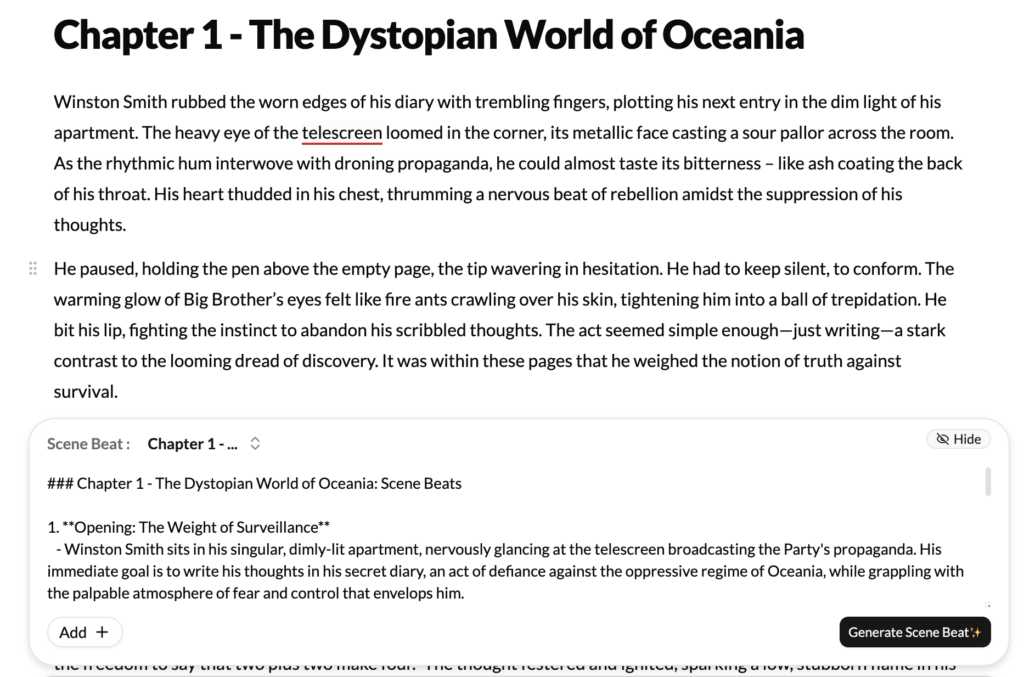
If the Outline is the architectural blueprint of your entire story, then Scene Beats are the detailed interior design plans for each individual room. This section of the Lore Book allows you to move from the high-level “what happens in this chapter” to the granular, moment-to-moment choreography of a specific scene.
A “beat” is the smallest unit of action or change within a scene. It can be a line of dialogue, a physical action, a character’s internal reaction, or a reveal of new information. By planning your scenes at the beat level, you gain precise control over your pacing, tension, emotional impact, and subtext. This is the tool for writers who want to ensure that every single moment on the page serves a purpose.
The Power of Granular Planning
While not every writer will plan to this level of detail for every scene, creating a beat sheet is invaluable for pivotal moments in your story, such as:
- High-Stakes Action Sequences: Choreographing a fight scene or a chase beat by beat ensures it is clear, logical, and exciting.
- Tense, Subtext-Heavy Dialogue: Planning the back-and-forth of a crucial conversation allows you to layer in subtext, secrets, and subtle shifts in power.
- Key Emotional Turning Points: Mapping out the emotional journey of a character within a single scene ensures their reaction feels earned and impactful.
- Complex Information Dumps: Breaking down the reveal of important lore or backstory into beats can help you deliver it in a more engaging and less expository way.
Structure of a Scene Beat Sheet
A beat sheet is essentially a numbered or bulleted list that outlines the cause-and-effect flow of a scene. A good scene typically involves a character with a goal, an obstacle, and a resulting change. The beat sheet maps this progression.
Example Scenario: In a chapter from your Outline called “The Interrogation,” the hero, Kaelen, must get information from a captured enemy spy.
Corresponding Scene Beats:
- Beat: Kaelen enters the cold, damp cell. The spy spits on the floor. (Establishes setting and initial conflict).
- Beat: Kaelen states his goal: “Tell me where the artifact is.” The spy laughs and refuses. (Goal and obstacle).
- Beat: Kaelen tries a tactic: intimidation. He describes the grim fate that awaits the spy. The spy remains defiant. (Action and reaction).
- Beat: Kaelen notices a unique ring on the spy’s finger, one he recognizes from his past. (A turning point/new information).
- Beat: Kaelen changes tactics. He doesn’t ask about the artifact; he asks about the ring. “Where did you get that?” (Shift in strategy).
- Beat: The spy’s confidence falters. He reveals the ring was a gift from his sister, who is also a captive of the same organization. (The reveal/leverage).
- Beat: Kaelen offers a new deal: not freedom, but a promise to save the spy’s sister in exchange for the information. (The new goal).
- Beat: The spy hesitates, then relents, revealing the artifact’s location. (Resolution of the scene’s primary goal).
- Beat: Kaelen leaves the cell, now burdened with a new promise and a more complicated mission. (The character has changed).
Using the Scene Beats Section
- Link to Outline: Each Scene Beats document should correspond to a specific chapter in your Outline.
- Focus on Cause and Effect: As you write your beats, think in terms of “Action -> Reaction.” Each beat should be a direct consequence of the one before it.
- Keep it Concise: Beats are not prose. Use short, descriptive phrases. The goal is to map the flow, not write the scene itself.
AI Assistance with Scene Beats
The AI can be a powerful collaborator at this granular level. You can ask it to:
- “Given this character’s goal and the obstacle, brainstorm five beats for how they might try to overcome it.”
- “Review this beat sheet. Is the pacing effective? Where could the tension be increased?”
- “This dialogue scene feels flat. Suggest some beats of subtext or non-verbal action to add another layer.”
By using the Scene Beats section, you are moving from being just a writer to being a director and choreographer. You are meticulously planning the performance of your characters and the emotional journey of your reader, ensuring every moment is crafted with intention and purpose.